GSR
Galvanic Skin Response (GSR), also known as electrodermal activity or skin conductance, is a physiological measure that reflects the electrical conductance of the skin. GSR is primarily influenced by sweat gland activity, which is controlled by the autonomic nervous system and can be modulated by emotional and cognitive processes.
The history of GSR dates back to the late 19th century when the French neurologist Charles Féré first discovered that the skin’s electrical conductivity changes in response to emotional arousal. However, it was not until the early 20th century that researchers began to study GSR more systematically.
In the 1920s, Fritz Kahn and Walter von Frey proposed that GSR could serve as an objective measure of emotional arousal. Their work laid the foundation for further research on the relationship between GSR and psychological states.
During the mid-20th century, GSR gained prominence in the field of psychophysiology and was used extensively in studies investigating emotional responses, stress, and anxiety. Notably, the American psychologist and biofeedback pioneer Neal E. Miller contributed significantly to the understanding and utilization of GSR as a measure of emotional and physiological arousal.
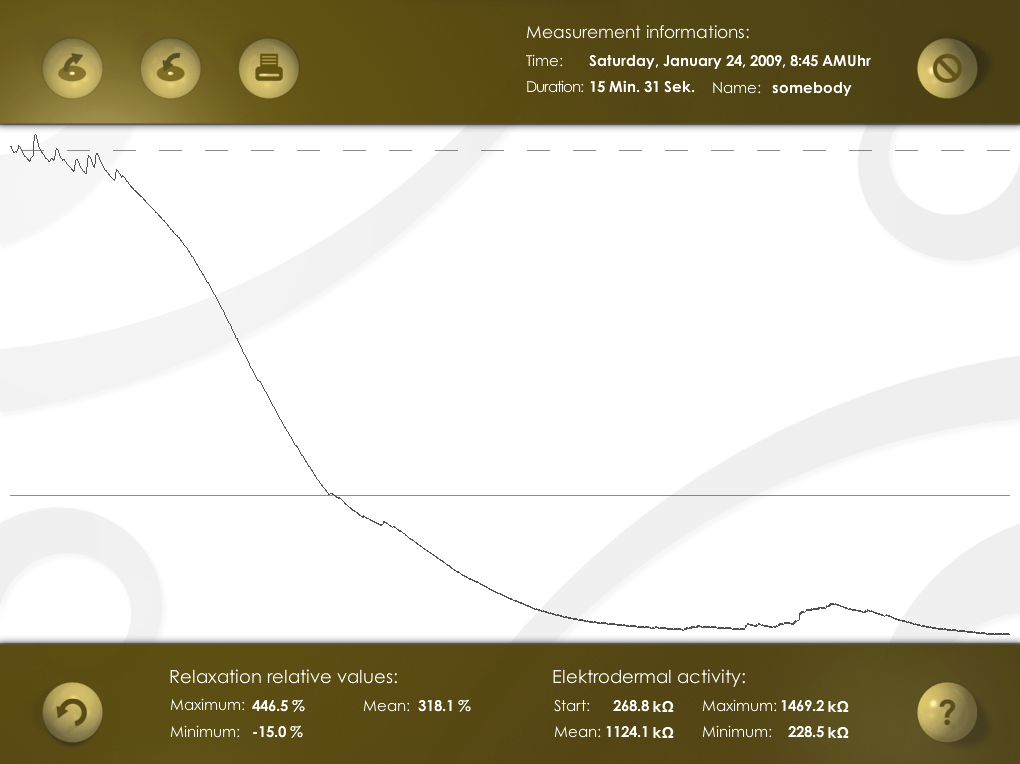
Here you can see what is possible:
A Russian woman on the MuSES, the precursor of the MindPeace System, reached with open eyes, just listening to special music, watching a slideshow and enjoying the micro-vibrations almost 450% relaxation.

In comparison:
A GSR measurement of a Thai business woman, Mrs. Daeng Oraphan in a VERIM seminar in Thailand.
In the first seminar in February 2009 she made 459% GSR change with open eyes and 629% with closed eyes. After one and a half month training with VERIM she reached so far the best world record of 821%, 19 minutes, eyes closed. This shows you how powerful your mind can be in self-regulation.
Advancements in technology, particularly in the development of reliable and portable equipment, made GSR more accessible for research and clinical applications in the latter half of the 20th century. It became a commonly used tool in fields such as psychology, neuroscience, and human-computer interaction.
Today, GSR is employed in various domains, including biofeedback therapy, stress management, emotion research, human factors engineering, and virtual reality applications. It is used to measure and understand emotional responses, stress levels, relaxation states, and physiological arousal in individuals.
In summary, Galvanic Skin Response (GSR) is a measure of the skin’s electrical conductance that reflects changes in sweat gland activity and is influenced by emotional and cognitive processes. Its history spans over a century and has seen significant contributions from researchers and pioneers in the field of psychophysiology and biofeedback.

Distributors:


Other platforms of VERIM OÜ:



Connected: